

Government social benefits help millions of Brazilian families cope with financial difficulties, access essential services, and seek greater stability in their daily lives.

Government social benefits
Learn about the main social benefits offered by the Brazilian government, how they work, who is eligible, and why keeping your Unified Registry (Cadastro Único) updated is important.
SEE HOW TO CONSULTYou will remain on this site
These programs can address different needs, such as income, food, housing, electricity, education, cooking gas, family care, and social protection.
For many people, government social benefits in Brazil serve as important support during times of low income, unemployment, vulnerability, or difficulty in covering basic household expenses.
The first step to understanding these programs is to know how they work. In many cases, entry is through the Unified Registry , which gathers information from low-income families and can be used in the selection process for different social programs.
This does not mean that all registrations guarantee automatic receipt of benefits. Each benefit has its own rules, income criteria, documentation, and analysis.
In this guide, you will understand what the main government social benefits are , how they can help, and why it's important to keep your information up-to-date to check for potential opportunities.
Main points
Government social benefits can help low-income families.
The Unified Registry is used as a basis for several social programs.
There are benefits related to income, energy, gas, housing, education, and social assistance.
Each program has its own rules for participation.
Keeping data up-to-date can facilitate consultation and prevent blocks or lost opportunities.
How do government social benefits work?
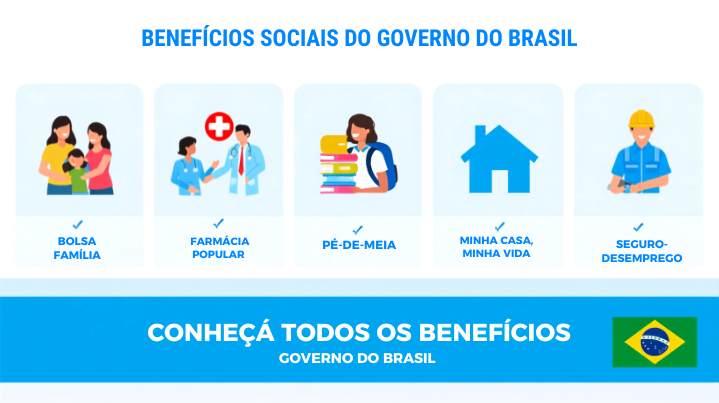
Government social benefits are programs designed to support families and individuals facing economic or social vulnerability.
They can be offered by the federal, state, or municipal government. Some are paid in cash, while others offer discounts, access to services, priority in programs, or specific support for certain situations.
In practice, the benefits can assist families with children, the elderly, people with disabilities, students, low-income workers, people without formal employment, or families struggling to pay essential expenses.
The process varies depending on the program. Some benefits require registration in the Unified Registry. Others may use information on income, family composition, age, education, health, or housing.
Therefore, it's important to understand that not all government social benefits work the same way.
A family may qualify for one benefit but not another. Similarly, an individual may need to update documents or correct information before they can proceed with the application.
The most important thing is to seek accurate information, organize the data, and check which programs may be available for your specific situation.
Single Registry: the gateway to various programs
The Unified Registry is one of the most important tools for those who wish to check their eligibility for government social benefits.
It functions as a registry of low-income families in Brazil. It contains information such as income, address, family composition, education level, employment, and other data used to identify the family's social situation.
According to the government, the Unified Registry is the gateway to more than 40 federal, state, and municipal social programs.
This includes income transfer programs, discounts, housing support, education, electricity, and other services.
Even so, being registered in the Unified Registry does not automatically guarantee receiving all benefits. Each program evaluates its own criteria.
The registration needs to be up-to-date, especially when there is a change of address, income, telephone number, birth of children, change in the children's school, or change in family composition.
For many families, keeping their Unified Registry (Cadastro Único) information accurate is the first step in ensuring they don't miss out on government social benefits.
Main social benefits available
There are several government social benefits that can help Brazilian families in different areas.
Some are better known, such as Bolsa Família. Others are geared towards specific situations, such as discounts on electricity bills, support for cooking gas, housing, education, or protection for the elderly and people with disabilities.
Among the most sought-after programs are:
- Family Scholarship.
- Gas Assistance.
- Social Electricity Tariff.
- Continuous Benefit Payment, known as BPC.
- My home, my life.
- Sock-and-Penny.
- Senior Citizen's Card.
- Youth ID.
- Fee waivers for some services.
- Municipal social assistance programs.
These programs may vary depending on the family's situation and availability in the region.
Therefore, before seeking any benefits, it is important to understand which need is most urgent: income, housing, food, energy, education, transportation, or family care.
This makes the consultation clearer and more focused.
By clicking the button you will remain on this site.
Bolsa Família and support for family income.
Bolsa Família is one of the best-known government social benefits programs in Brazil.
It was created to support families living in poverty and help guarantee a minimum income, food, health, and education.
Access to the Bolsa Família program is through the Unified Registry, and its management involves the federal government, states, and municipalities.
This benefit can be important for families who need to supplement their monthly income and cover basic household expenses.
Beyond the financial aspect, the program also connects with areas such as health and education. Therefore, keeping family information updated is essential to avoid problems with monitoring.
Families with children, teenagers, pregnant women, or people in situations of greater vulnerability should pay extra attention to their registration information.
The Bolsa Família program can be one of the main sources of support for those seeking more stability, but it is not the only benefit available.
Therefore, it's also worth knowing about other government social benefits that can supplement family support.
Gas subsidy, social tariff and essential discounts
In addition to income benefits, there are programs aimed at basic household expenses.
The Gas Assistance program can help low-income families cope with the cost of cooking gas. Meanwhile, the Social Electricity Tariff can offer discounts on electricity bills for families that meet the defined criteria.
These subsidies are important because they reduce fixed household expenses.
For many families, saving on electricity or receiving gas-related support can ease the strain on their budget and allow the money to be used for other needs, such as food, medicine, transportation, or school supplies.
These government social benefits often depend on up-to-date data and specific criteria.
Therefore, those registered in the Unified Registry should check if their family information is correct and if their profile qualifies them for any of these programs.
Discounts and benefits may seem small individually, but they make a difference when added to the monthly budget.
BPC, housing and other social protection programs
The Continuous Benefit Payment, known as BPC, is another important program within the social protection network.
It is aimed at senior citizens and people with disabilities who meet the income criteria and other legal requirements.
Unlike some temporary programs, the BPC has specific rules and requires more detailed analysis. Therefore, it is essential to verify the requirements before starting any application.
In addition to the BPC, there are also housing-related programs, such as housing initiatives aimed at low-income families.
The home environment is one of the most important factors for family stability. Having a safe place to live directly influences health, children's education, access to work, and quality of life.
Other government social benefits may include documentation, social assistance, support for families at risk, and referrals made by social service units.
Therefore, it's best not to focus on just one benefit. Many families may need a combination of support to reorganize their lives.
Education, youth, and opportunities for low-income families.
Government social benefits may also include programs related to education and youth.
Some support programs are geared towards school retention, study encouragement, transportation, food, documentation, and access to opportunities.
The "Pé-de-Meia" program, for example, appears among the main programs linked to the Unified Registry and education, according to official government information on social programs.
This type of benefit can be important for young people from low-income families who need to continue studying and build better opportunities for the future.
In addition to federal programs, states and municipalities can also offer their own assistance, such as school transportation, materials, food, courses, training, or support for young people in vulnerable situations.
Education is one of the most important areas for breaking cycles of financial hardship.
Therefore, families with children and teenagers should pay attention to programs that help with school attendance and child development.
How to prepare to check on social benefits
Before inquiring about government social benefits , it's important to organize your information.
Preparation helps to avoid mistakes, missed deadlines, and difficulties in the analysis.
The first step is to check if the family is registered in the Unified Registry or if they need to update their information. The government informs that any low-income family can register for free, and registration is done in person at a service center in the city where the family lives.
It's also important to separate essential documents.
The required documents may vary, but they generally include:
- Identification document.
- CPF.
- Proof of address.
- Proof of income, if available.
- Birth certificate of children.
- Documents belonging to family members.
- Proof of school enrollment, when required.
In addition to the documents, pay attention to your contact information. Phone number, address, and family composition must be correct to avoid problems.
Another important point is to understand that each benefit has its own rules.
Therefore, before attempting to apply, it's worth checking which government social benefits match your situation: family income, number of people in the household, presence of children, elderly people, students, or people with disabilities.
With everything organized, the next step becomes simpler: consult the step-by-step guide to check which benefits may be available and how to proceed correctly.
By clicking the button you will remain on this site.
Conclusion
Government social benefits can offer important support to Brazilian families facing financial or social difficulties.
They can help with income, food, gas, energy, housing, education, social assistance, and other essential needs.
The Unified Registry plays a central role in this process because it gathers information from families and can be used to access different programs.
Even so, it's important to remember that each benefit has its own criteria. Therefore, being registered does not mean automatic approval.
The best approach is to keep your data updated, be aware of the available options, and follow the correct consultation process.
With information and organization, it becomes easier to identify which government social benefits in Brazil might make sense for your family.
By clicking the button you will remain on this site.
FAQ
What are government social benefits?
These are programs designed to support families and individuals in vulnerable situations. They may involve income support, discounts, services, housing, education, food, and social protection.
Who is eligible to receive social benefits from the government?
It depends on each program. In general, many benefits take into account family income, household composition, age, presence of children, elderly people, students, or people with disabilities.
Does the Unified Registry guarantee the receipt of benefits?
No. The Unified Registry is a gateway to several programs, but each benefit has its own analysis and selection criteria.
What are the main social benefits provided by the government?
Among the most sought-after programs are Bolsa Família (Family Allowance), Auxílio Gás (Gas Assistance), Tarifa Social de Energia Elétrica (Social Electricity Tariff), BPC (Continuous Benefit Payment), Minha Casa Minha Vida (My House My Life), Pé-de-Meia (Savings Program), Carteira do Idoso (Senior Citizen's Card), and ID Jovem (Youth ID).
How do I know if I'm entitled to any benefits?
The first step is to check your status in the Unified Registry, keep your information updated, and consult the requirements of each social program.
Do I need to update my Single Registry?
Yes. Whenever there is a change in income, address, phone number, school, the birth of children, or a change in family composition, it is important to update the information.
Can I receive more than one social benefit?
In some cases, yes. It depends on the rules of each program and the family's situation.
Where can I find information about government social benefits?
The consultation can be done through official channels, Unified Registry service points, CRAS (Social Assistance Reference Centers), applications, and digital services available according to each program.
Are social benefits paid every month?
Not all. Some benefits are monthly, others bimonthly, occasional, or offered as a discount or service.
What is the first step in seeking a benefit?
The first step is to organize your documents, check your Unified Registry (Cadastro Único), and understand which programs match your family's situation.